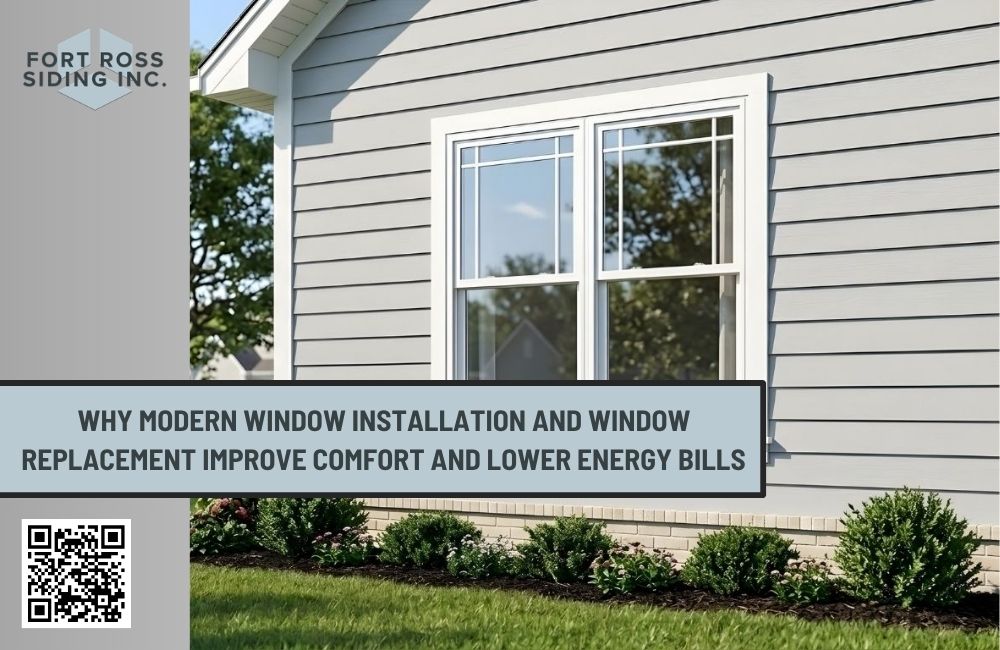
Why Modern Window Installation and Window Replacement Improve Comfort and Lower Energy Bills
New window technologies have increased comfort and energy benefits, and have provided more practical options for consumers. Most homeowners don't think about their windows until something goes visibly wrong a crack, a stuck sash, or a puddle of condensation that ruins the windowsill paint. By then, those windows have usually been underperforming for years: letting heat pour in during summer, allowing cold air to seep through in winter, and quietly inflating every utility bill along the way.
The good news is that modern window installation and window replacement technology has advanced significantly over the past two decades. Today's windows are engineered to manage heat transfer, reduce noise, resist moisture, and hold up to weather extremes in ways that original construction-grade windows simply weren't designed to do.
This article breaks down exactly how that works the science behind modern window performance, the real-world comfort and cost benefits homeowners experience, what to look for in a quality installation, and how pairing window work with siding installation or siding replacement delivers even greater results. If you've been wondering whether it's worth the investment, you'll have a clear answer by the end.
The Problem With Old Windows and Why It's Costing You More Than You Think
Older windows, particularly aluminum-framed single-pane units common in homes built before the 1990s were functional for their era. But they weren't designed with energy efficiency in mind. Aluminum conducts heat and cold almost as readily as the outdoor air itself, providing essentially no thermal resistance between the exterior temperature and your interior living space.
Even many early double-pane windows from the 1990s and early 2000s are now reaching the end of their useful life. The seals that contain the insulating gas between the panes degrade over time and once that seal fails, the window's insulating capacity drops dramatically. You'll typically see this as fog or haze between the panes that don't clear. It's a permanent failure, and no amount of cleaning fixes it.
What failing windows actually cost you
The U.S. Department of Energy estimates that heat gain and loss through windows accounts for 25–30% of residential heating and cooling energy use. In climate zones like the Sacramento Valley where summers regularly exceed 100°F and HVAC systems run for six months straight that percentage represents a real and measurable portion of your monthly utility bill. Energy efficient windows are an important consideration for both new and existing homes.
Beyond the utility cost, underperforming windows create uneven comfort throughout the home. A south-facing living room with old single-pane glass becomes nearly unusable in July. A bedroom with failed double-pane units feels drafty through December no matter how warm the rest of the house gets. These aren't minor inconveniences, they're quality-of-life issues that follow homeowners through every season until the windows are addressed.
How Modern Windows Actually Work “The Technology Behind the Performance”
Understanding what makes modern windows different helps explain why window replacement delivers such a noticeable improvement. The upgrade isn't just about newer glass it's about a system of components that work together to manage heat, moisture, and noise at the building envelope level.
Low-E glass coatings
Low-emissivity (low-E) coatings are microscopically thin metallic layers applied to the glass surface. They work by reflecting radiant heat either blocking solar heat from entering in summer, or keeping interior heat from escaping in winter, depending on how the coating is specified. For Sacramento Valley climates with hot, sun-intensive summers, a solar-control low-E coating on the exterior surface of the inner pane is the correct specification. It reduces solar heat gain before it enters the glass entirely.
Thermally broken frames
The frame is where older aluminum windows fail most conspicuously. Aluminum conducts heat at roughly 1,000 times the rate of wood or vinyl which means an aluminum window frame is essentially a continuous thermal bridge between outdoor and indoor temperatures. Modern vinyl and fiberglass frames interrupt this pathway with non-conductive materials, dramatically reducing heat transfer at the frame perimeter. This is what eliminates the cold frame condensation that was common with aluminum windows in winter.
Insulating gas fills and edge spacers
Double and triple-pane windows trap insulating gas typically argon or krypton between the glass layers. Argon is 34% less thermally conductive than air; krypton is even more effective in narrower gaps. The quality of the edge spacer that maintains the gap and seals the unit is what determines how long this insulating capacity holds. Higher-quality spacers using "warm edge" technology extend the useful life of the sealed unit significantly particularly in high-UV or extreme-temperature climates.
Window type and seal design
Not all window types seal equally well. Casement and awning windows which compress against a continuous perimeter gasket when closed provide better air and weather sealing than double-hung windows, whose sliding sashes rely on brush seals that degrade over time. For wind-exposed or weather-prone elevations, the window type is a performance specification, not just a style preference.
The Real-World Benefits Homeowners Experience After Window Replacement
The technical explanation matters, but what homeowners actually care about is what changes after a professional window installation project. Here's what consistently improves:
Room-to-room temperature balance
Rooms that previously overheated in summer or felt cold in winter reach and hold comfortable temperatures more easily without the HVAC system compensating continuously.
Lower monthly utility bills
Reduced heat gain in summer and heat loss in winter means HVAC systems run less to maintain the same interior temperature. The savings are measurable and often noticeable in the first full season after installation.
Reduced exterior noise
Double-pane glass with quality edge spacers provides meaningful acoustic dampening. Homes near busy streets or arterials notice this improvement immediately after window replacement.
No more condensation on frames
Thermally broken frames eliminate the cold surface that causes interior condensation in winter removing the moisture source that leads to mold, paint damage, and windowsill rot over time.
UV protection for interiors
Low-E coatings block a significant portion of UV radiation, protecting flooring, furniture, and artwork from the fading and degradation that direct sun causes over time.
Improved home value
Updated windows are one of the few exterior improvements that appear in both buyer inspection reports and appraisals. Quality window installation contributes to market value and reduces the negotiation surface at listing time.
Why Pairing Window Work With Siding Installation Makes Practical Sense
Windows and siding are exterior partners; they share wall space, share flashing details, and when one is failing, the other often is too. Many homeowners who contact us about window replacement end up combining it with siding installation or siding replacement once they see the full exterior picture during the assessment.
The practical case for combining them is straightforward. Both projects require exterior staging. Both require integrated flashing at every window opening and when windows and siding are installed together, that flashing is continuous and correct from the start, rather than being retrofitted when the second project follows later. You also avoid two rounds of disruption, two scheduling cycles, and the inevitable mess of construction in consecutive years.
What siding contributes to energy performance
Siding isn't just decorative. Properly installed exterior cladding with sealed penetrations, correct lap overlap, and integrated house wrap or vapor barrier improves the wall assembly's overall thermal resistance and moisture management. When siding fails through cracked seams, warped panels, or failed caulk around window openings it creates pathways for both air infiltration and moisture that directly affect interior comfort and structural integrity.
Siding replacement with fiber cement, James Hardie, or quality vinyl products addresses these failures and contributes to the whole-wall thermal performance that energy-efficient windows are part of. The wall system works together and it performs best when all components are correctly specified and installed at the same time.
Finding the right contractor for combined projects
When searching for a siding installer near me who also handles window work under one license and one guarantee, the credential to verify is a California D-41 Siding and Decking classification alongside a B General Building license. Both mean the contractor is qualified to handle the full exterior scope windows and siding without subcontracting one trade to another. Subcontracting creates accountability gaps between the two systems that show up as installation problems later.
What a Professional Installation Actually Involves and Why It Matters
The window itself is only part of the equation. A well-specified window installed incorrectly will fail to deliver its rated performance and may introduce moisture problems that a cheaper window installed correctly wouldn't. This is why professional window installation is worth the difference over a big-box store kit or an unlicensed crew working from a pickup truck.
Precise field measurement. Windows ordered to exact rough opening dimensions not standard sizes shimmed to fit. A window that fits properly seals properly.
Rough opening preparation and flashing. The opening is flashed before the window goes in sill pan, jamb wrap, and head flashing creating a water management system that directs any infiltration outward rather than into the wall cavity.
Continuous perimeter sealant. Exterior sealant applied at the frame-to-siding junction using products rated for the local temperature range not standard residential caulk that cracks under thermal cycling.
Final operation testing. Every sash tested for smooth operation, correct lock engagement, and weathertight closure before the crew leaves not left for the homeowner to discover problems later.
Complete cleanup. Old window and siding materials removed and disposed of properly. The site is left clean, not left for the homeowner to manage.
When to Replace Practical Signs It's Time to Stop Waiting
Not every window that looks old needs immediate replacement and a good contractor will tell you that honestly. But several specific conditions are clear signals that continued waiting is costing you more than the project would:
Fog or haze permanently between the panes
Drafts you can feel at the closed frame
Visible rot, warping, or cracking in the frame
Sashes that stick, won't lock, or are difficult to operate
Rooms with persistent temperature imbalance
Energy bills climbing with no other explanation
If your siding shows any of the following alongside these window symptoms soft panels near window frames, bubbling paint, caulk failure at lap seams, or moisture staining on interior walls the two projects belong on the same schedule.
The Bottom Line: Modern Windows Are an Investment That Pays You Back
Modern window installation and window replacement aren't just about aesthetics or correcting a problem they're about measurably improving the way your home performs every day. Cooler in summer, warmer in winter, quieter throughout, and less expensive to heat and cool. The technology is there. The question is when to act on it.
The answer, for most homeowners with windows showing any of the signs described above, is: sooner than later. Every season of delay is a season of higher utility bills, continued comfort problems, and potential moisture damage accumulating behind surfaces you can't see.
Whether you need a single window addressed or a full exterior overhaul combining window replacement with siding installation, the process starts the same way: a free, honest assessment of what your home actually needs from a licensed contractor who will put the project cost in writing before any work begins.
Ready to find out what your home actually needs?
Fort Ross Siding & Windows offers free on-site assessments for Sacramento-area homeowners. We'll evaluate your windows and exterior, tell you honestly what we'd recommend and what we wouldn't bother with and give you a written, itemized quote before any commitment is required.
Fort Ross Siding & Windows
Address: 2437 Harris Ave, Sacramento, CA 95838
Phone: +1 (916) 474-1941
